
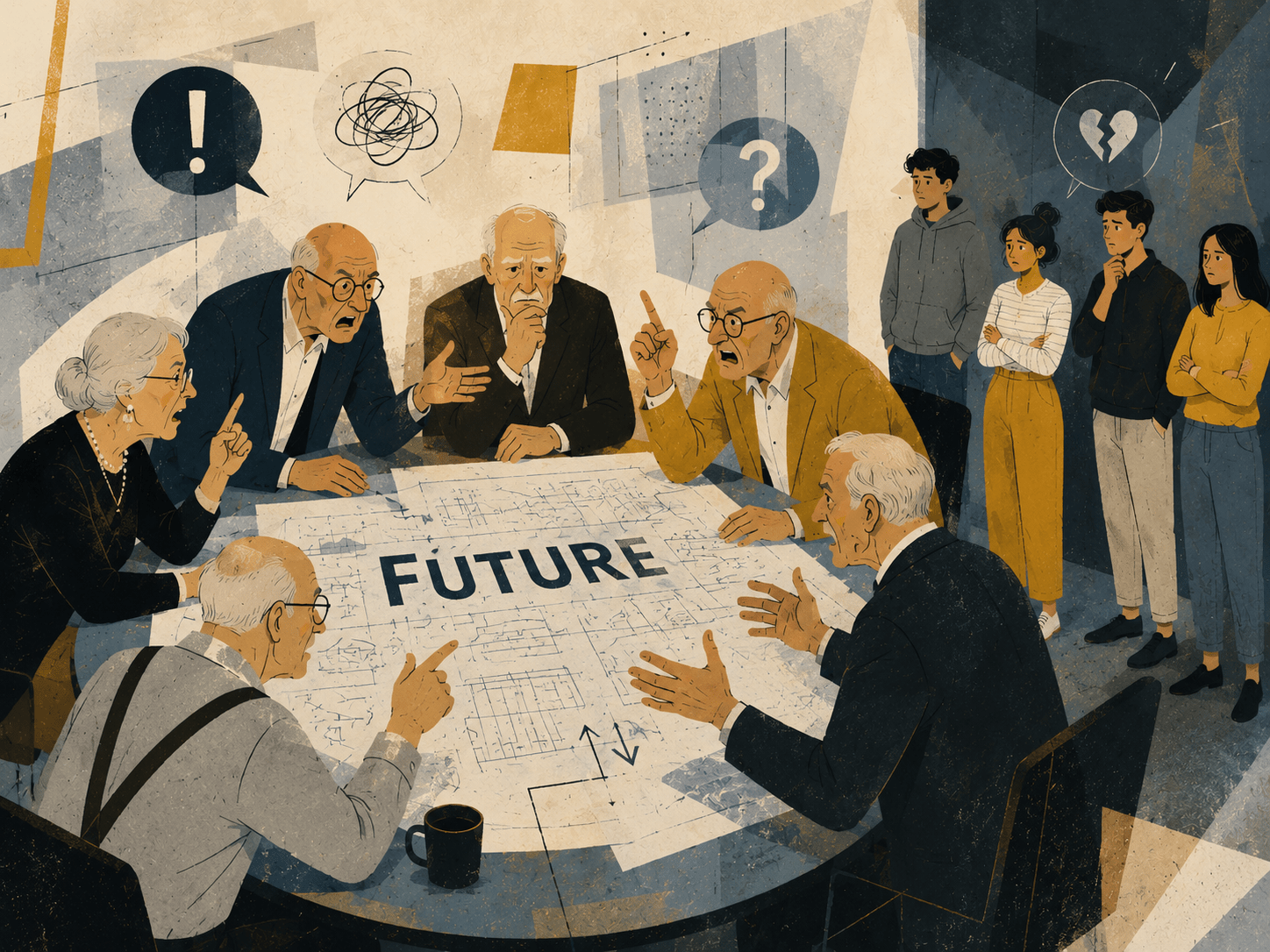
Yale Law School professor Samuel Moyn argues that the fate and character of the US is being determined not by forward-looking young people, but those in the final third of their lives.
The “generation war” narrative has been around for as long as there have been generations.
Aristotle said the young “think they know everything, and confidently affirm it”, while older people “live in memory rather than in hope”.
People are living longer and healthier and this has implications both for countries and for wealthy families.
In democracies
- The numbers win
- Time cycle is from one election to the next
- Demographic shifts are significant
Families are not democracies (as I’ve told our kids many times). In families
- Power and governance are key factors
- The approach of those in power is significant
- Time cycles are much longer
In a family, a lot will depend on the governance currently in place.
Family governance rules range from non-existent (‘undocumented’ might be a better term) to being so constrained that they are tantamount to ruling from the grave.
In most cases, there will be long periods of time where the older people in the family are making decisions that significantly impact the younger people, and indeed family members yet to be born.
The well-known quote from the Hermès family is “You do not inherit a family business. You borrow it from your grandchildren”.
That approach turns the family balance sheet on its head, and reflects governance with a strong sense of stewardship and humility, and a time-cycle in decades.
This is where the approach of those in power at any time is most important.
If they embody a Hermès-style attitude, they will make decisions thinking about the needs of future generations. They may invite younger family members to participate in the process, even though they may not have any legal decision-making power.
That achieves two things for the younger family members:
- Recognition that they are stakeholders
- Preparing them to be stewards
For years I thought that a member of the Hermès family coined that saying. In fact, back in 1971, the environmental activist Wendell Berry wrote that “a true conservationist knows that the world is not given by his fathers, but borrowed from his children”.
In democracies, people largely vote with self-interest in mind. Dwindling birth rates mean ageing populations place a larger burden on the youth. Progress isn’t the overthrow of the old by the young, rather that we all want to leave behind a world better than the one we found.
Families don’t suffer from the scale and diversity challenges of countries.
Everyone in the family can be raised with the goal of leaving behind a world better than the one they found.
Conversation Starters:
- How long have the decision-makers in your family been in those roles?
- What term-limit policies does your family have to avoid decision-makers becoming ‘stale’?
- How does your family recognise the stakeholders and future owners/stewards?
- What is done to engage and prepare them?
Further Readings:
60% of Asia’s HNW not planning for succession
Time for Saudi families to review their succession plans
WHY PLANNING FOR SUCCESSION IS PLANNING FOR SUCCESS
HOW FREEDOM FROM WEALTH AS YOU AGE CAN OPEN A NEW WORLD OF POSSIBILITIES
Succession Planning: 20 Tips For A Smooth Transition Of Leadership
Murdoch succession battle: Estate planning lessons for multi-gen wealth
Generational conflict has been around forever – just ask the ancients
Are Americans Too Old?

