
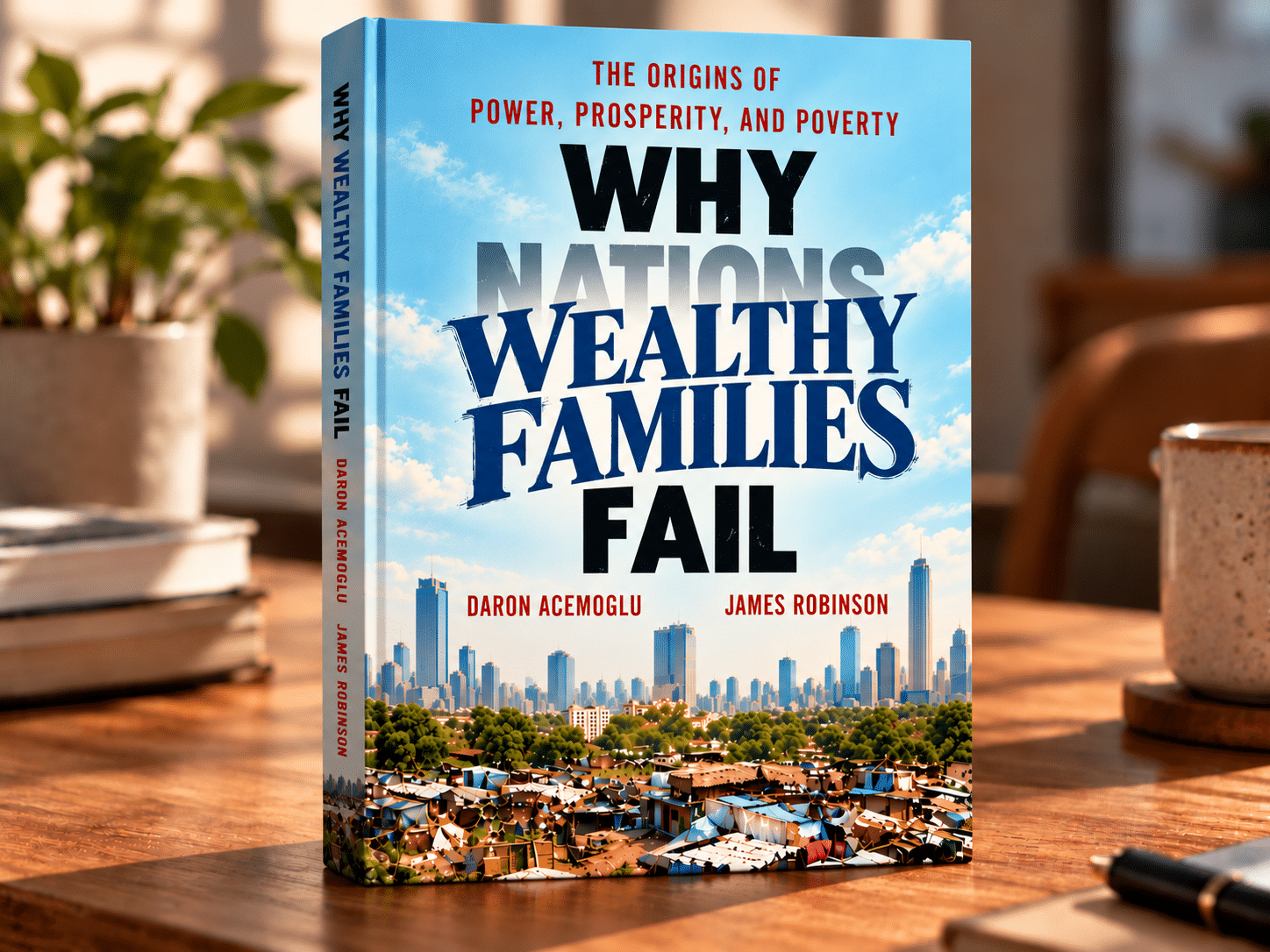
Countries, non-profits, families: they all have something in common.
They are about something bigger and more enduring than the individual, and where stewardship and shared purpose are essential.
I thought about this recently while reviewing Why Nations Fail (Acemoglu and Robinson, 2012).
The book asks why some countries prosper over generations while others don’t. Counterintuitively, they suggest that it’s not about natural resources, geography or culture. Rather, it is the quality of their institutions.
They distinguish between inclusive and extractive institutions.
Inclusive institutions spread opportunity and participation broadly. Extractive institutions concentrate power and resources among a small group. Over time, those differences become self-reinforcing.
There’s a fascinating parallel with wealthy families.
In many first-generation families, almost everything naturally revolves around the wealth creator.
- They made the money
- They understand the business
- They know the investments
- They have relationships with the advisors
So … they make the decisions.
That may work extremely well for decades.
But what happens when the family wants the wealth to survive beyond the person who created it?
Some families respond by building structures around the wealth while continuing to concentrate the actual decision-making.
There might be trusts, boards, investment committees and a family office.
Yet the next generation may still know surprisingly little about what the family owns, why it owns it, or how decisions are made.
They are beneficiaries of the system rather than participants in it.
That is where Why Nations Fail offers a useful way of thinking.
A family can have very sophisticated structures without having inclusive institutions.
A great example of this in action is the “the kids aren’t ready” trope, which is repeated often from wealth creators when discussing succession.
They don’t believe the next generation has the experience or judgement to make significant decisions.
But there’s an obvious problem: how are they supposed to acquire that experience if they aren’t allowed to make decisions?
This can either be a vicious circle or a virtuous one:
The vicious circle is: they don’t have the experience, so we will keep doing it for them, and they never get the experience.
The virtuous circle is to start with smaller decisions. Give the rising generation genuine responsibility for some philanthropy. Bring them into investment discussions. Let them observe boards before joining them. Give them responsibility for a project with real consequences.
They will sometimes make different decisions from the ones their parents would have made. They will even … make mistakes.
But none of that is evidence the experiment has failed.
It’s how judgement develops.
Participation builds capability. Capability builds confidence. And confidence allows greater responsibility.
Important to note that “inclusive” doesn’t mean democratic.
A family isn’t a democracy. Not everybody needs an equal vote, and children don’t automatically have the right to make decisions simply because they belong to the family.
Good governance is about putting decisions in the right place.
But if a family wants future generations to become good stewards of its wealth, those generations need opportunities to practice stewardship before they inherit it.
Financial capital can transfer from one generation to another overnight.
The ability to manage it cannot.
Instead of asking “will the next generation be ready?”, ask “what are we doing today that will help them be more ready?”
Family prosperity is neither accidental nor predetermined. We reap what we sow.
Conversation Starters:
- What level of participation do rising gen family members have?
- Where in your family is decision-making concentrated?
- What decisions could the rising generation start making today that would better prepare them for tomorrow?
Further Readings:
All in the family
NAVIGATING THE FAMILY BUSINESS SUCCESS(ION) MAZE
The Rising Generation’s Role in Family Offices
The Coming Family Office Succession Wave Ushers In Structural Changes
What Is Generation Jones And Why It’s Reshaping Succession Planning
Why Family Office Leaders Should Think Like Mentors, Not Executives


Hey David – yet another interesting post! Keep ‘m coming. My response is ‘how do you define a family’s failure’? I define it less in financial terms and more in relational terms. Wealth preservation isn’t the primary goal, family preservation is. My perspective is that poorly managed conflict is why families fail. But, I agree that conflict can have its roots in how shared / generational finances are set-up and managed. Poor financial planning and ‘inclusion’ can certainly trigger conflict. But – it’s how conflict is managed that makes the difference.