
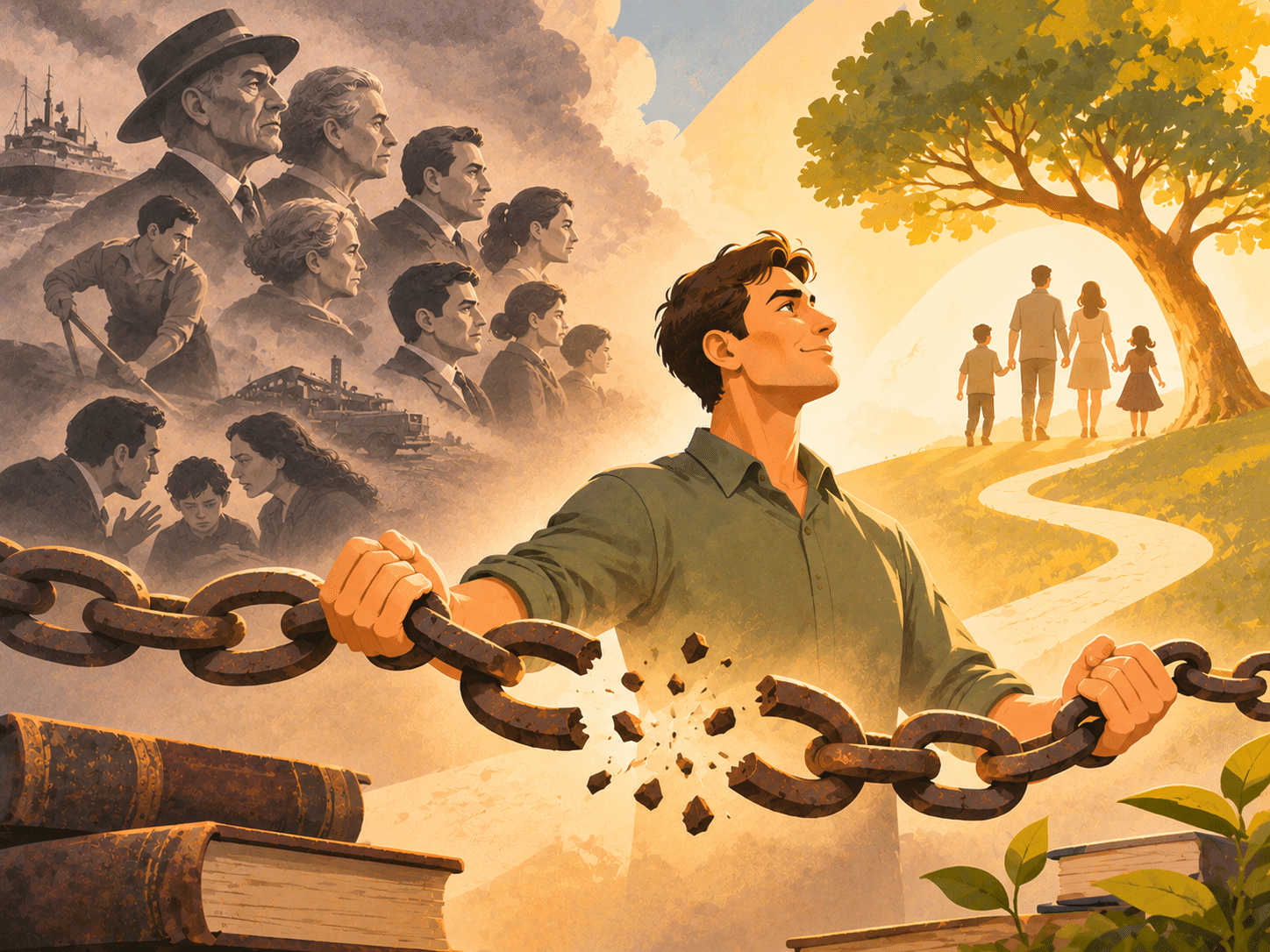
Storytelling has the amazing power not just to convey events, but also the lessons and values that we learn from them. They are an outstanding and effective way to transmit culture.
The stories that families tell (and don’t tell) define the family’s culture.
“Grandpa worked hard after the Great Depression to build a huge business” speaks to overcoming adversity, and the importance of hard work. “Did Grandma starve on a ship coming to this country so you could throw out food?” uses guilt to perpetuate behaviour that may not be relevant in the current environment.
“History doesn’t repeat itself, but it rhymes” (incorrectly attributed to Mark Twain). Particularly in families, patterns repeat through generations.
If Grandpa had a big fight with family over the business, and Mum did too, what are you doing differently to ensure it won’t happen in your generation?
One reason these patterns repeat is because they are baked deep into the subconscious and the culture through storytelling. They are just “how we do things in our family”, for better or worse.
At this point, I will digress into the Book of Genesis, which is full of stories about dysfunctional families.
At the start of Genesis, God favours the younger brother (Abel) over the elder son (Cain), and the result is murder. At the end of Genesis, Jacob favours the younger grandson (Ephraim) over the elder (Manasseh), and the result is far better. Not only do the brothers themselves remain on good terms, but they join their ten uncles as the Twelve Tribes and foundation of a people that has endured for several thousand years.
The (family) stories in Genesis don’t need to be read as a history book. They are a vehicle for conveying lessons and values.
Even more so, they are a case study of families breaking intergenerational patterns: sibling rivalry, jealousy, favouritism, fairness, communication.
How did they do it? We don’t have insights into the family conversations and self-reflection that at various stages led to a different approach.
What we can do is look at those stories and learn from them – adapt the concepts and apply them in our family contexts.
Sometimes we see things in our own families and think “I want to be just like that in my own family”. Sometimes, the response is “I want to be the opposite”.
And sometimes, we just go with the flow. By doing that, we aren’t taking agency over our future. We are just passengers in rhyming family history.
My late father was a micro-manager, and very successful in business. I saw that and chose to be a delegator in my own businesses. I couldn’t be Him 2.0; I needed to be Me.
That took work.
It takes difficult discussions where family narratives are challenged.
It takes individuation to recognise the human frailty of our high achieving ancestors.
It takes self-reflection to bring awareness to the patterns we are repeating.
Most of all, it takes the courage to decide to do things differently.
Conversation Starters:
- What stories does your family tell? What have you learned from them?
- What repeating patterns exist across generations?
- In what ways are you similar to your parents? In what ways different?
- If there was one thing you could do differently to your parents, what would it be?
If learning from the Book of Genesis piques your interest, check out my program Genesis of Legacy.
Further Readings:
MINING THE PAST: HOW ‘HISTORY SCRIPTING’ STRATEGIES CAN HELP FAMILY BUSINESSES ACHIEVE COMPETITIVE ADVANTAGES
Family Businesses Need To Tell Their Story Better. Here’s Why.
In Praise of the Idle Rich Wastrel

